At Alexir Partnership, sustainability isn’t layered on at the end. It’s part of the foundation of each project we enter and shapes how we design, source, test and manufacture packaging.
Sustainable design is complex. It requires balancing functionality, recyclability, food safety, legislation and commercial viability. It demands technical knowledge, responsiveness and the confidence to challenge existing norms. But where there’s a will, we’ll find the way.
Considerations for sustainable packaging design
Designing sustainable food packaging comes with real technical constraints.
Reducing plastic
Cuan, our Technical Sales Manager explains:
“The biggest challenge is the plastic content in the products. We try as far as possible to limit or reduce the amount of plastic, while still keeping it a functional pack.”
In many food applications, particularly modified atmosphere packaging, plastic plays a critical role in maintaining shelf life and preventing gas leakage. Reducing plastic content cannot compromise product integrity.
Legislation also shifts quickly. “Previously the plastic content could be under 10% to be considered kerbside recyclable. But they’re soon to reduce it to below 5%,” Cuan explains.
A single regulatory change can alter the recyclability status of a format. Sustainable packaging design therefore has to be agile and forward-thinking.
Product visibility
Visibility is another key consideration where retailers and consumers often want to see the product. But larger windows increase plastic usage. Our teams regularly advise on reducing window size and increasing recycled content, but where windows are essential, we’re constantly watching and testing advancements in organic materials that could one day replace plastic altogether.
We know that our clients are on the constant look out for sustainable solutions, with high-volume searches on search engines for sustainability including:
- Plastic free packaging
- Paper food packaging alternative
- Compostable packaging UK
- Biodegradable food trays
- Cardboard instead of plastic packaging
Our aim is to deliver on each of these points. We’re making great inroads…
Halopack: reducing plastic without sacrificing performance
Alexir is Halopack’s sole UK partner and we’ve worked with Halopack since 2015, holding a close relationship with the global Halopack network.
Halopack offers a huge sustainability win for brands. As Cuan summarises:
“It’s 90% recyclable, so once you remove the film, the bigger part of the packaging just goes straight through the recycling process.”
Regulatory changes in sustainable packaging
Recyclability depends not only on material composition but also on regulatory thresholds. The upcoming changes reducing the plastic content limit from 10% to 5% will present new challenges, particularly for ovenable packs, where film can bond to board at high temperatures.
Rather than retreat, we’re currently working directly with film producers to reduce plastic content further while maintaining modified atmosphere functionality. This includes testing on a current project that has reduced plastic content below 5% while retaining performance.
Innovation is strengthened through collaboration. Through the Halopack global portal, technical learnings and trial data are shared internationally.
“We actually have an online portal where we share information, we can share our learnings and hear about successes from around the world that we can replicate.”
This shared innovation network ensures UK clients benefit from global insight while contributing to wider industry progress.
StackPack: expanding sustainable formats into snacking
StackPack is another card-based product. It was originally developed for the fresh produce market and we’ve worked with this format for the release of breakthrough products such as Boombites, a hybrid of the grape entering the ‘superfood’ market.
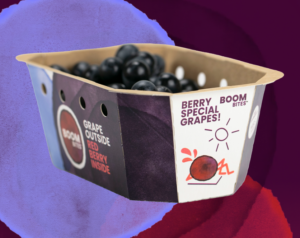
We’re working with brands to deliver this innovation into the wider snacking market, replacing more plastic-intensive alternatives with carton formats. This includes partnering with Marks & Spencer as they advance their own sustainability goals, and supporting Tesco in transitioning snacking sausage rolls and pork products into cartons, helping to remove plastic from the market.
With the right partners, sustainable packaging formats can scale beyond niche applications into mainstream retail categories.
Moving away from forever material
Reducing plastic is only part of the equation. Replacing it responsibly is equally important.
Alexir is actively seeking alternatives to long-lasting synthetic materials. One current development involves a starch-based coating created with an innovative supplier.
This coating:
- Is applied during the print processActs as a moisture and grease barrier
- Contains no plastic
- Is fully recyclable and dissolvable
As Cuan explains:
“It’s almost like an ink – it’s a coating that just seals and there’s no plastic whatsoever. It’s 100% recyclable.”
And because sustainable innovation must perform technically as well as environmentally, all materials are independently tested for compliance with food contact regulations including EC 1935/2004 and EU 10/2011.
From concept to credible prototype
One thing that sets Alexir Partnership apart when it comes to sustainable packaging design is our ability to deliver fully branded prototype packs within a week. Where once clients were presented with unprinted board mock-ups, Alexir now produces fully branded prototype packs in as little as seven days. These prototypes reflect the final in-store appearance and allow brands to assess structure, branding and format in realistic conditions.
“We can basically give you a finished looking product within the week… it’s what you will see in-store.”
This capability is powered by the integration of creative, pre-press, print and co-packing expertise within the business and enables brands to trial sustainable packaging formats quickly and refine before scaling.
Proven in practice
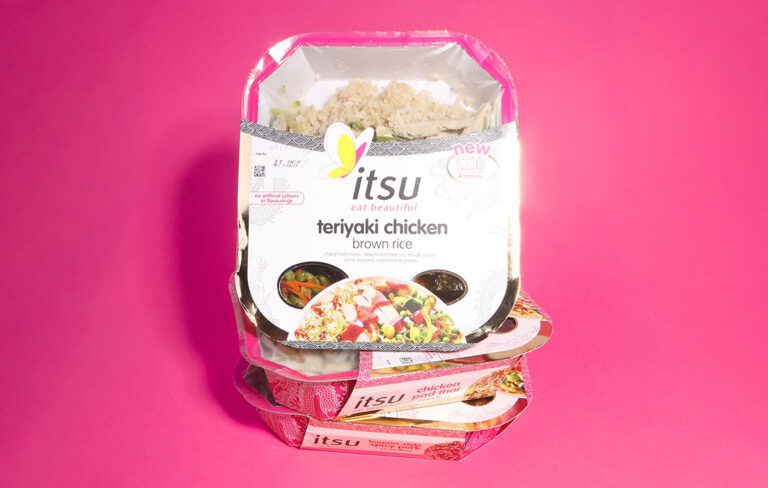 Our Itsu case study demonstrates how structural redesign can deliver both environmental and commercial benefits. It is a clear example of how creative packaging engineering and sustainable thinking work together.
Want to explore what’s possible?
If you’re looking to reduce plastic content, trial plant-based coatings or develop carton-based alternatives, we’re ready to support you.
Our integrated creative and manufacturing capabilities allow us to design, test and develop sustainable packaging solutions that perform in the real world. Contact us to discuss what is possible.
